
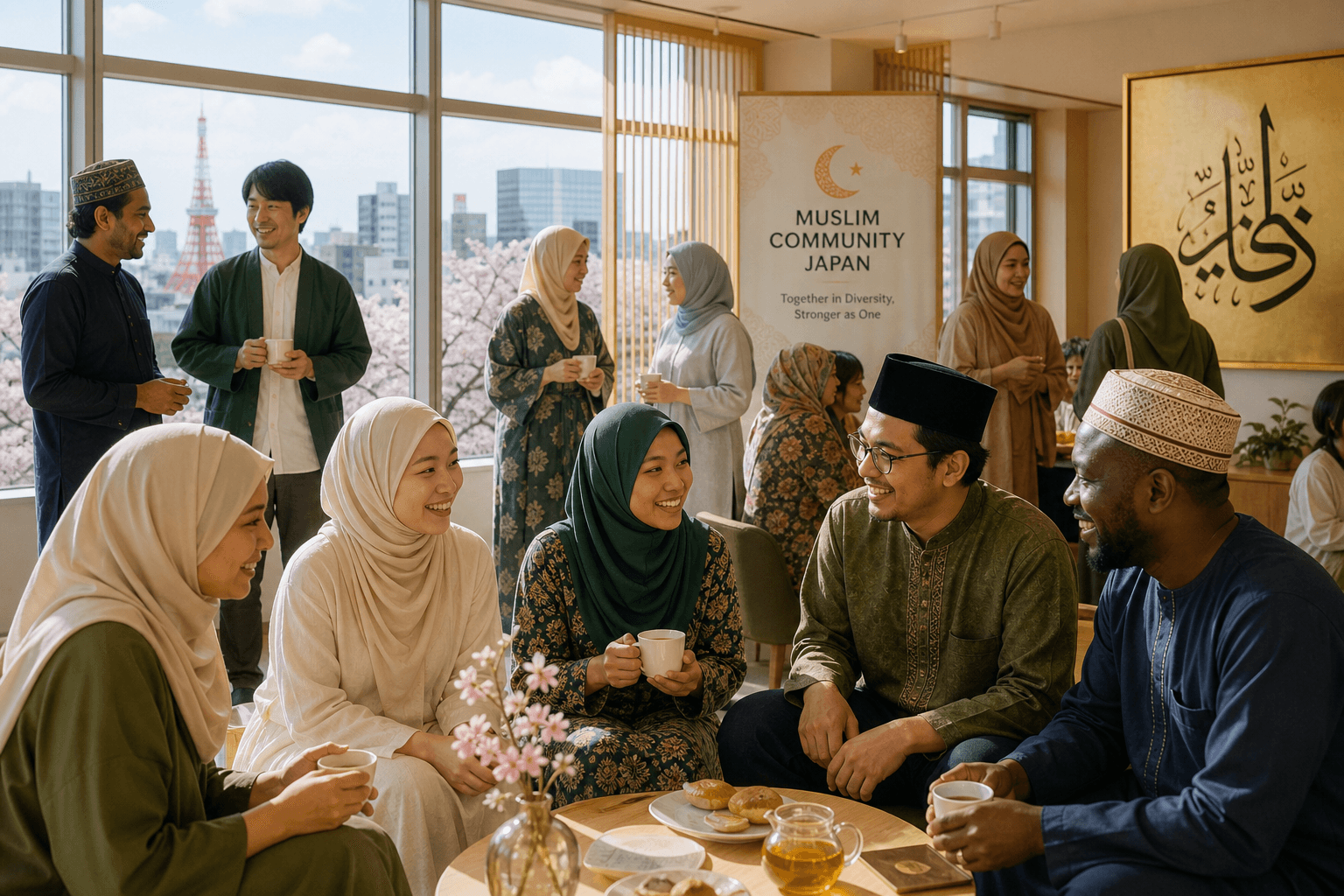
Ask most people to describe the Muslim community in Japan and they will say: “small and isolated.” The reality in 2026 is considerably more complex, more vibrant, and more significant than that summary suggests. Japan is home to one of the most culturally diverse Muslim populations in Asia — a community shaped by Ottoman history, post-war migration, Southeast Asian student networks, and a new generation of economic migrants who have quietly built something remarkable.
A Brief History: Islam Arrives in Japan
The first documented encounter between Japan and Islam came not through missionaries or traders but through geopolitics. In 1890, the Ottoman naval vessel Ertuğrulsank off the coast of Wakayama Prefecture in a devastating storm, killing 587 crew members. Japanese locals risked their own lives to rescue 69 survivors. The story of Japanese compassion toward Ottoman Muslims became foundational — and the friendship between Japan and Turkey established during those rescue efforts persists to this day. Tokyo Camii, Japan’s largest mosque in Shibuya, was built with Turkish state support and stands as a permanent symbol of that bond.
The first permanent Muslim community in Japan took root in Kobe in the early 20th century — predominantly South Asian and Middle Eastern merchants who came for trade. The Kobe Muslim Mosque, built in 1935, is the oldest mosque still standing in Japan and one of the few buildings in Kobe to survive both the Second World War firebombing and the 1995 Great Hanshin Earthquake largely intact. It remains an active centre of worship and is listed as a significant architectural and cultural landmark.
Who Are Japan’s Muslims Today?
Precise figures are difficult — Japan does not record religion in its census data. The most widely cited estimates place Japan’s Muslim population between 100,000 and 300,000, with the most credible academic surveys (notably those conducted by Waseda and Keio universities) suggesting a figure of approximately 200,000 as of 2024–2025, and growing.
The community is strikingly diverse:
- Indonesian Muslims form the largest single group — driven by Japan’s active recruitment of Indonesian technical interns, Tokutei Ginou workers, and university students. The Indonesian Muslim community is particularly well-organised, with active associations in Tokyo, Osaka, and Nagoya.
- Pakistani and Bangladeshi Muslims have been present in Japan since the 1980s and form a significant portion of the long-term resident community, particularly in Tokyo’s Toshima and Adachi wards.
- Malaysian Muslims are represented through a strong student community, particularly around Japan’s national universities. Many Malaysian alumni of Japanese universities remain in Japan long-term.
- African Muslims — particularly from Nigeria, Senegal, and Egypt — have a growing presence, mainly in Tokyo and Osaka, involved in trade, IT, and education.
- Japanese converts to Islam — the most overlooked group, yet one of the fastest growing. Estimates suggest 10,000–40,000 Japanese nationals have converted to Islam, with motivation often coming through relationships with Muslim partners, academic study, or independent spiritual seeking. Japanese converts frequently speak about the resonance between Islamic values (cleanliness, order, community, sobriety) and traditional Japanese culture.
“What surprises most people is how quietly established the Muslim community in Japan already is. Mosques, halal restaurants, Islamic schools, burial grounds — the infrastructure is here. It is not perfectly complete, but it is far more developed than people imagine.”
Where Do Muslims Live in Japan?
The Muslim population is concentrated in Japan’s major urban centres, closely tracking employment and education hubs:
- Greater Tokyo — the largest concentration. Shibuya (Tokyo Camii), Toshima (Otsuka Mosque), Adachi, Edogawa, and Sumida wards all have significant Muslim populations. The Takadanobaba area of Shinjuku has become an informal hub for South Asian Muslim businesses.
- Osaka-Kobe corridor — the second largest community, historically significant through Kobe’s trading past. Ibaraki City in Osaka Prefecture houses one of the most active mosques in western Japan.
- Nagoya / Aichi Prefecture — Japan’s manufacturing heartland has attracted significant numbers of Indonesian and Vietnamese Muslim workers through the technical intern and Tokutei Ginou programmes.
- Kyoto and university cities — Kyoto, Tsukuba, Sendai, and Sapporo all have active Muslim student communities centred around major universities. This population is young, educated, and growing.
- Rural and regional Japan — increasingly present as the Tokutei Ginou programme places workers in agricultural, fishing, and manufacturing communities outside major cities. This is the least-served part of the community in terms of halal food, mosques, and social support.
The Marriage Question
For Japan’s Muslim community, marriage is among the most practically complex challenges. The community is scattered across a large country, diverse in nationality and culture, and operating in a social environment where Islamic matrimonial norms — wali involvement, family-mediated introductions, modesty in courtship — have no natural parallel in mainstream Japanese society.
Historically, many Muslims in Japan found partners through mosque networks, family introductions from their home countries, or online matrimonial platforms designed for other markets (Malaysian, Pakistani, or pan-Islamic apps). None of these serve the Japan-specific reality well — the geographic scatter, the multicultural nature of the community, the unique combination of Japanese and Islamic values that a couple navigating life in Japan needs to share.
Al-Nikah Japan was built in direct response to this gap. A Japan-specific, privacy-first, nikah-focused platform where the full diversity of Japan’s Muslim community — Japanese, Indonesian, Pakistani, Malaysian, Nigerian, converts — can find sincere introductions on their own terms.
Where Are We Headed?
Japan’s Muslim community is at an inflection point. Government policy has fundamentally shifted — Japan now actively recruits foreign workers, with the expanded Tokutei Ginou programme bringing thousands of Muslim workers from Southeast Asia and South Asia annually. At the same time, Japan’s domestic Muslim population is increasingly second-generation: children born in Japan to Muslim parents, educated in Japanese schools, fluent in Japanese, holding Japanese values alongside their Islamic faith.
This second generation is perhaps the most significant development. They do not see themselves as temporary workers sending remittances home. They are home. Japan is their country. And they are beginning to build institutions — halal businesses, Islamic schools, community organisations — that reflect that permanence.
The story of Islam in Japan is not finished. In many ways, it is just beginning.
Written by
Al-Nikah Japan Editorial
The Al-Nikah Japan editorial team researches and writes guides, news, and community content for Muslims living in Japan. We are based in Japan and write from lived experience within the community. To contribute, contact us at support@alnikah.pro.